
Why Noxilizer
ISO 11040-8:2026 Raises the Bar for Prefilled Syringe Terminal Sterilization
ISO 11040-8:2026 represents an important evolution in how prefilled syringe performance is considered. The new standard shifts greater attention toward the integrity and performance of the finished syringe system and introduces new requirements addressing container closure integrity (CCI), unintended plunger stopper movement and the sterile barrier zone.
Critically for sterilization, ISO 11040-8:2026 specifically recognizes changes in air pressure, including those occurring during sterilization as a potential cause of plunger stopper movement.
ISO 11040-8:2026 sets a new requirement
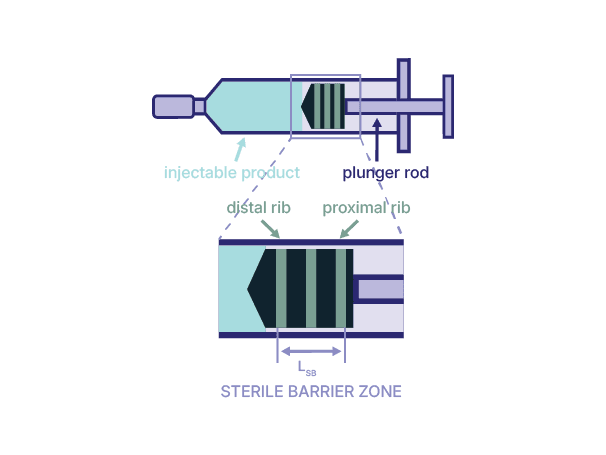
Integrity must be maintained
Clause 7.4: integrity shall be maintained through filling, terminal sterilization, transport and storage.
Movement is limited to LSB
Clause 6.13: design and assembly shall ensure movement stays below LSB, the length between the distal and proximal sealing contacts.
Clause 6.13 prescribes no test
It requires a risk assessment and a design that holds movement below LSB. It points to ideal gas law calculation.
For more information on the key changes in ISO 11040-8:2026 vs. the 2016 standard
Why plunger stopper movement matters
A finished prefilled syringe is a container-closure system. During sterilization, changes in chamber pressure can act on that system, causing the plunger stopper to move within the syringe barrel. These pressure changes can be far more dramatic than those that might occur during normal shipment, even by airplane.
Process risks include:
Sterilant reaches the drug
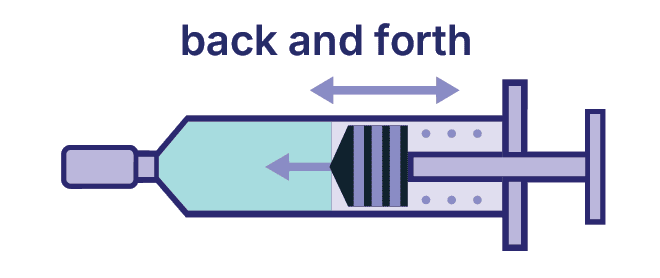
Each vacuum and pressure step moves the piston out and back. It carries sterilant along the barrel into the drug product.
Micro-organisms are shielded
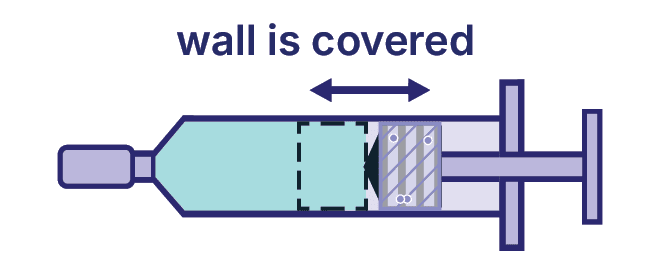
The piston covers part of the barrel wall. Sterilant never reaches that surface. Micro-organisms there survive.
Container closure integrity
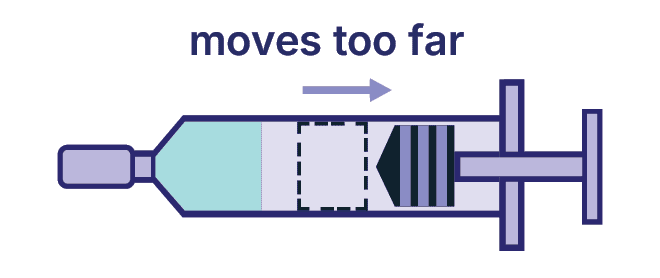
ISO 11040-8 Clause 6.13: if the piston moves beyond the sterile barrier zone, sterility may be lost.
There is another important consideration: plunger stopper movement can reverse as pressure changes. The plunger stopper may return to or near its starting position, meaning post-sterilization visual inspection may not reveal that the movement occurred.
Not all sterilization processes carry the same risks
The implications of sterilization modality extend beyond sterility assurance alone. Manufacturers must consider how sterilization conditions can affect sterile barrier and container-closure integrity, device functionality, drug compatibility and long-term performance.
NO₂ sterilization offers fundamentally different processing options:
- Near-ambient, minimal vacuum processing reduces pressure-driven plunger stopper movement and helps protect sterile barrier and container-closure integrity.
- Ultra-low temperatures of 10–30°C help protect drug integrity and device performance while minimizing thermal stress and the risk of protein degradation.
- Strong material compatibility supports long-term integrity and functional performance.
The difference is measurable
Noxilizer evaluated four common syringe designs across three different headspace levels, to simulate the evacuation steps of a cycle.
533 mbar
Noxilizer’s Near Ambient Cycle
0 / 12
syringes crossed the sterile barrier zone
133 mbar
DEEP VACUUM Cycle
7 / 12
syringes crossed the sterile barrier zone
27 mbar
DEEP VACUUM Cycle
9 / 12
syringes crossed the sterile barrier zone
The bottom line: Noxilizer’s near-ambient cycle met the ISO Clause 6.13 movement requirement in this testing. Deep-vacuum conditions failed to meet the requirement for 9/12 syringes tested.
For more details on these experiments and the implications with respect to ISO 11040-8:2026
A new standard. A stronger case for near-ambient sterilization.
ISO 11040-8:2026 puts increased emphasis on how the entire finished PFS performs, and specifically recognizes the role that pressure changes during sterilization can play in plunger stopper movement.
For manufacturers of prefilled syringes and biologic combination products, that makes sterilization process conditions an increasingly important design consideration, and strengthens the case for the near-ambient, ultra-low-temperature conditions of NO₂ sterilization.
Talk to Noxilizer about evaluating NO₂ sterilization for your prefilled syringe or combination product